 |
| Octopus arm |
 |
Me, with a model bat
above |
 |
Model proboscis
monkey |
In the
last entry, I wrote about seeing the wading birds, otters, and seals at
Living Coasts; this time, it's the turn of those truly aquatic creatures that reside below the waterline!
To get to the aquarium section, there are first more decorated corridors - lined with information at the ends - to explore. At first glance, a hallway leading to an aquarium being adorned with foliage and prop forest creatures, such as fruit bats and proboscis monkeys might seem strange. However, it became clear why the passageway was adorned in such a manner when it opened out into the Mysterious Mangroves area.
 |
| Mysterious Mangroves |
This area was home to creatures such as rays (blue spotted & blue spotted ribbontail), four-eyed fish, spotted scats, silver moonies, banded archer fish, and Atlantic mudskippers, figure of eight puffer fish, Australian fat-bellied seahorses, and greater pipefish, among others.

The open tanks had fabricated mangrove trees in their relatively shallow waters, which simulated the habitat that their dwellers would be found in naturally. Two of them also had a bridge (for visitors to walk over) connecting them together. which allowed for a larger tank area, giving the animals more freedom in which to swim - it was good!

Another beneficial aspect of the open tanks in this area was the ability to see them from virtually 360 degrees. It was much easier to see them clearly like this. Although that didn't particularly enrich the environment for the animals, it didn't
detract from it for them either, which was the important thing!
 |
| A blue spotted ray, "smiling" for the camera |
It was fascinating just watching the various species mingle and interact with each other and we spent a fair amount of time just gazing at all of them. However, I don't have much to write about them individually, because this space was bustling with constant activity. So, for most of them, I'll let the images write for me in this case.
 |
| A four-eyed fish |
 |
| Spotted scats |
 |
| A spotted scat |
 |
| A spotted scat |
 |
| Blue spotted rays |
 |
| Blue spotted ribbontail rays and a blue spotted ray |
 |
| A figure of eight puffer fish |
Most of the creatures in these tanks moved in shoals or small groups, but there was one who was noticeably solitary and stood out from the others. This was mainly because it was sitting on a rock the whole time!
 |
| An Atlantic mudskipper |
The mudskipper is an amphibious species of fish that can breathe through its skin and the lining of its mouth and throat, as long as it is kept in moist/humid conditions. In addition to this, it has special adaptations to its gills that allows it to retain air bubbles, allowing it to breath on land, and can "walk" using its pectoral and pelvic fins when on the ground. It was a really fascinating little fish!
 |
| Australian fat-bellied seahorse |
 |
| A lobster |
 |
| Secret seahorse |
Next, we headed over to another set of tanks - this time closed-top ones. There were extremely shy seahorses in one tank, unexpectedly curious pipefish (and their offspring in a nursery) in another, and sea anemones (beadlet & snakelock), lobsters, hermit crabs and shrimp in the remaining tanks in this space.
 |
| Spiny star fish and a common blenny |
We then came to an open-top local coasts tank, which was filled with star fish, anemones, and common blennies, and was surrounded by information pertaining to the waters around Torbay. It was really interesting to see them up close and learn more about them.
 |
My friend took a photo of me under
the tank. Thanks, friend! :P |
 |
A spiny star fish &
a snake lock anemone |
In addition to being able to view the creatures from above, this tank also allowed visitors to crawl underneath it and view its inhabitants from below. So naturally, I had to do that, despite getting a few odd looks from other guests. haha. (The big sign on the tank said I could go underneath, so I did! Too bad for everyone else, I guess; they missed out on seeing interesting things!).
 |
| Spiny star fish, from below |
After that, we walked through corridors/viewing areas - including the seal and penguin underwater viewing pools that I mentioned the previous post - with information about various sea creatures, until we came to the "children's play area".
 |
| "Fish are Friends" wall mural |


There were bright murals/paintings on the walls, plus lots of aquatic-themed toys for children to play and interact with. As well as that, there was, again, lots of information for people to read, both with their children and just for themselves.
In this room, there was also a tank of Mangrove - upside down - jellyfish.
 |
| Mangrove jellyfish (Cassiopea) |
 |
| Mangrove jellyfish (Cassiopea) |
They were very beautiful creatures: pale pink in colour with white and blue on their arms. They float with their bells facing the ground, mouths and arms facing the surface. When catching prey and defending themselves, they use nematocysts (stinging cells), which may cause a skin rash or itching in humans (depending on the person). However, it is not known to cause a serious reaction (in humans), as is the case with some jellyfish species.
There were three tanks in the following section; the first contained a lovely common octopus. We watched it for a while and then a keeper / information assistant asked me if we were there to watch the feeding. In truth, I'd forgotten what time it was, but since I didn't want to waste the opportunity to find out more about the octopus, I said yes. We were the only ones there, so we got to hear everything about the species, the way they feed and also ask any other questions that we had. It was great!

The octopus used its arms very dexterously. Its food - a small squid - was put inside two tubes and in order eat it, first the octopus had to remove it from both. The speed with which this task was achieved surprised even the keeper on this occasion!
 |
| The common octopus in its paler colour state before feeding |
 |
| A lionfish |
Opposite the octopus there were two more tanks: one with lionfish inside and one with a white spot puffer fish inside. There were three lionfish and none of them seemed to be very active. I didn't know much about this species before my visit, so I was a little bit concerned for their well-being when I saw them.
However, I've since read more about them and have learnt that they are actually just quite inactive fish, preferring to have rocks to hide and nestle amongst. So this tank was perfect for them, really! (Of course professionals would know more than me, haha).
 |
| The white spot puffer fish |
In contrast to the lionfish, the white spot puffer fish was extremely active - interactive even! It swam along, watching us pass by and following us. It was very endearing. (I do realise that the inside of the tanks are somewhat mirrored, but it followed our movements exactly).
The reason that it was kept in a tank by itself is because this type of puffer fish are solitary and can be aggressive and territorial to others of its species (and, I would assume, other species too). So perhaps it wasn't being endearing but, rather, telling us to clear off! I still think it was adorable though.

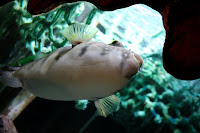


The next area was the last area and featured a lot of information, models and displays on all sorts of marine creatures, such as cephalopods, sharks and other fish. It was really interesting!

Overall, Living Coasts was a really wonderful and fascinating place to visit and I'd recommend that anyone who gets the chance to go does so! Visiting on a weekday - particularly Monday to Thursday - is the best if possible, as those are the least busy days and will allow you to see everything at your leisure and also give you time to go back to anything you want to see again.
Goodbye from me and the magical manatee model~!


 The open tanks had fabricated mangrove trees in their relatively shallow waters, which simulated the habitat that their dwellers would be found in naturally. Two of them also had a bridge (for visitors to walk over) connecting them together. which allowed for a larger tank area, giving the animals more freedom in which to swim - it was good!


 There were bright murals/paintings on the walls, plus lots of aquatic-themed toys for children to play and interact with. As well as that, there was, again, lots of information for people to read, both with their children and just for themselves.


 The octopus used its arms very dexterously. Its food - a small squid - was put inside two tubes and in order eat it, first the octopus had to remove it from both. The speed with which this task was achieved surprised even the keeper on this occasion!


