|
| A goat licking my hand at "The Ranch" |
So far in my
Paignton Zoo posts I've written about the '
Reptiles, Amphibians & Fish', the '
Birds & Big Cats', and the '
Primates & Medium to Large Mammals'. This post, however, is all about the 'The Ranch & Everything Else'. Essentially, that means that it's about the domestic animals that were in the small "petting zoo", some of the plants (there were hundreds - if not thousands - of them!), and anything else that didn't quite fit into the other categories.


When I was a small child, I constantly asked my parents for a pet goat for some reason (instead, we had dogs, and now I have cats, because obviously keeping a goat requires very specific land and keeping requirements to make them happy and healthy) and I've had something of an arbitrary fascination with them ever since. So getting to interact with the goats at The Ranch is always something I love doing. The particular goat in the photos above first tried sniffing my hand, then licking it, and then finally gently tried to eat my fingers (don't worry, there was hand sanitiser at the Ranch exit!). It didn't hurt at all, but it
was rather amusing. It also tried to devour my coat later as well! I still think goats are wonderful, haha.
 |
| The dainty, staring goat |


 |
| The contented goat |


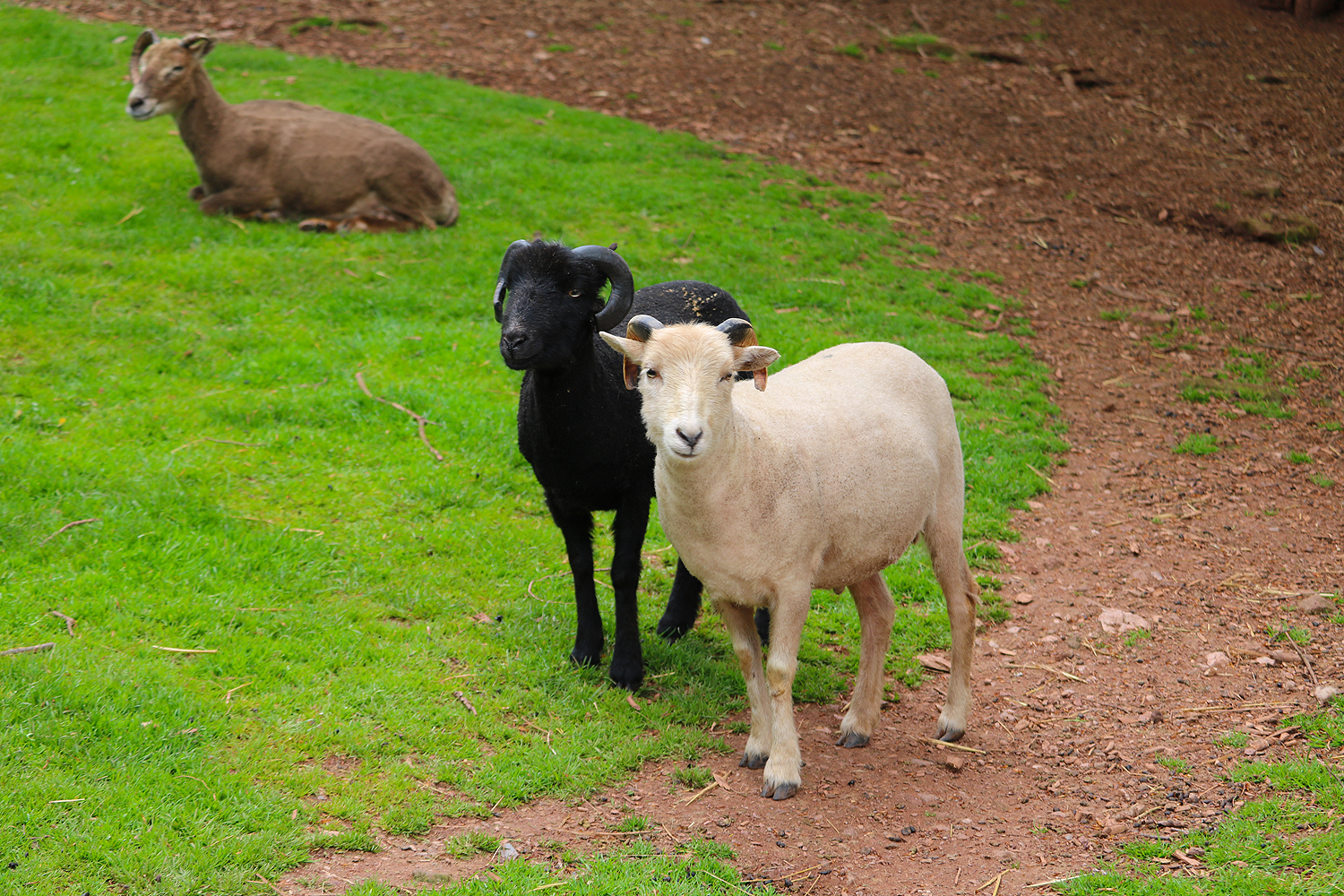
The goats weaved in and out of a small herd of Soay sheep, which had been sheared for the summer. I've mentioned before that I find all animals fascinating and, though I won't be writing about them as much as the goats in this post, sheep are no exception
 |
| A goat getting a neck scratch |
As soon as the sheep heard the keepers preparing their food, there was a sudden mini-stampede to one end of The Ranch and the goats were left to slowly amble their way along, getting neck scratches as they went.

 |
| Soay Sheep |
 |
| The three colours of Soay sheep |
We followed the sheep and goats, down a slight incline, to the other end of the enclosure. There, we found a single goat posing by a coop, with three charming chickens.
 |
| The posing goat with its feathered friends |
When we turned the corner, the rest of the chickens and some of the goats were pottering in and out of the covered barn - the chickens hopping on and off tables and flapping about - and a few pregnant/unwell sheep were in some of the stalls being checked over by a vet.
 |
| A statuesque hen |


 |
| A strutting cockrel |
Just before my friend and I left The Ranch, we noticed another strange creature lurking in one of the former meerkat tunnels. We managed to take this bizarre photo of it:
 |
A Semi-Wild Mother
(Mater monstruosus) |
Moving on from The Ranch and to the "Everything Else" section, mentioned in the title of this post, we spotted what we at first thought was a hedgehog:
 |
Lesser Hedgehog Tenrec
(Echinops telfairi) |
In fact, the creature above is a lesser hedgehog tenrec, taking its middle name from the striking similarity in appearance to its namesake. However, despite their outward appearance, tenrecs are a separate species to hedgehogs entirely!
We also saw some meerkats, huddling together and preening under a heat lamp.
 |
Meerkats
(Suricata suricatta) |

They kept trying to stretch up as tall as they could inside it, in order to get closer to the heat bulb. The silver reflector dish made them look like they had on some kind of "brainwave machine" from a cheesy old sci-fi film!

 |
Meerkat
(Suricata suricatta) |
In the same enclosure, there was a lone crested porcupine snuffling and sniffing about.
 |
Crested Porcupine
(Hystrix cristata) |


We didn't have the opportunity to see or hear it elevating and shaking its quills. Although it's probably an impressive display, I think it's so much better that the porcupine be happy, healthy, and not stressed!
 |
Crested Porcupine
(Hystrix cristata) |
Nearby, there were some lovely animals I'd never heard of before: cusimanses. They're actually a form of dwarf mongoose that are found in the the West African countries of Ghana, the Ivory Coast, Benin, Liberia, and Sierra Leone in the wild.
 |
Common Cusimanses
(Crossarchus obscurus) |
Cusimanses are apparently very sociable and this was very evident as we observed them, as they never strayed too far from one another.
 |
Common Cusimanse
(Crossarchus obscurus) |
We ventured over to the nocturnal house and, at first. we couldn't see the adorable sloth snoozing between the tree branches, as our eyes were still adjusting to the dark. It kept extremely still and, most of the time, I was unsure whether or not the furry mass was actually the sloth. However, just before we left it slightly lifted it's head and we got a glimpse of its bear-like little face, confirming its identity!
 |
Two-toed Sloth
(Choloepus didactylus) |
 |
Meerkats
(Suricata suricatta)
|


Some other occupants of the nocturnal house were meerkat pups, which were, just like their adult counterparts, huddled under a heat lamp. I assume that they were in the nocturnal house because they were so young and meerkat pups usually stay within the darkness and protection of underground tunnels, in the wild, but they don't have any in the meerkat enclosure. It probably also allows them to be more easily monitored and looked after by zoo staff.
There was a lone pup, not moving, in the light of a separate lamp to all the others. To begin with, it was a little bit worrying, as it didn't even seem to be breathing.
 |
Meerkat
(Suricata suricatta)
|
Thankfully though, it eventually started moving around and it turned out that it had just been sleeping really deeply. It must have been left behind by its siblings when they moved over to the other lamp, as it went to join them almost immediately!
 |
Maned Wolf Sign
(Chrysocyon brachyurus) |
The last animal I have to write about is one we didn't actually see: the maned wolf. They're mostly nocturnal and so I've actually only seen a wolf once, in any of the times I've visited Paignton Zoo. I did take a photo of this sign with a maned wolf footprint cast though.
As you walk around the zoo, it's not only the zoo animals you see, but a myriad of wild birds, insects, arachnids, (and occasionally other invertebrates too), and small mammals (squirrels, for example) too. This is mainly due to the diverse and healthy plant, fungi and tree species that grow throughout the park's grounds. Everything from snowdrops to giant redwoods to cacti and other succulents to daisies to giant lilypads! It's such a magical place to walk around.
Not only that, but there are sculptures dotted around the place too - some subtle and blending in, some bold and standing out. It's very much like the flora and fauna of the zoo!
 |
| Wooden meerkat sculptures & a variety of plants |
 |
| A gorilla sculpture made as part of a charity project |
Below are some photographs of just a fraction of the species of plants - both wild and cultivated - that the zoo contains (other notable species include giant rhubarb and trees such as the giant redwood):


Of course, as the zoo is such an attractive place to wildlife, it was inevitable that the most wild domestic creature living among us would also find a way to make themself at home...
 |
| A domestic cat sleeping in the leaf litter |
Sleep well, kitty!
And with that, I conclude my adventures at the zoo and transition back to my everyday life with cats, haha!